
Check Los Angeles Voter Registration
The Los Angeles County Voter Registration Verification form is a self-service status check. Enter the information as it appears on the registration record. Each field is required, so a surname alone will not produce a list of people. The form also points voters to vote-by-mail status, polling-place, election-worker, and vote-by-mail application services.
- Enter the registered last name using letters only.
- Supply the birthdate in month/day/year form.
- Add the numeric house number and ZIP code for the residence address.
- Submit the combined details and review the returned status. For help, call the county at (800) 815-2666, option 2.
The exact Los Angeles search fields are narrow by design:
| County field | Input type | Required? | Accepted form |
|---|---|---|---|
| Last Name | Text | Yes | Alphabetic characters only |
| Birthdate | Date | Yes | mm/dd/yyyy |
| House Number | Numeric text | Yes | Numbers only, from the residence address |
| Zip Code | Numeric text | Yes | Numbers only |
The county verification screen shows how those inputs are grouped. View the official LA County status tool before entering personal data.
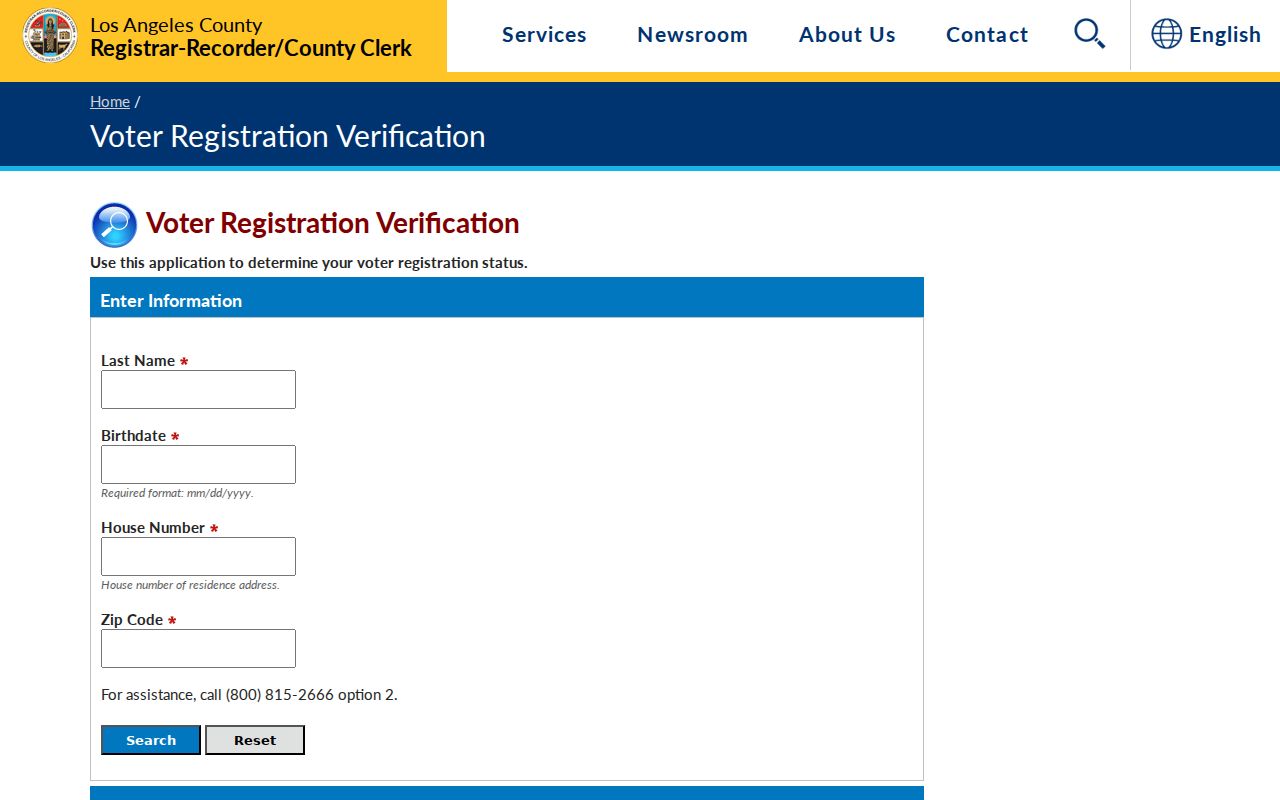
The captured form confirms that a valid check depends on all four details, not on an open name search.
Los Angeles Voter Lookup Myth
A common mistake is treating the voter roll like a public phone book. California does not provide an unrestricted resident search. The county tool verifies one voter's details, while the California My Voter Status service offers a separate statewide self-check. Both require personal identifiers. Neither is a way to browse neighbors, relatives, or every person with the same surname.
This split matters when a result fails. First, check the spelling, birthdate, house number, and ZIP. Then use the county assistance number or the state service. A formal data request is not a shortcut around a failed personal status check because the applicant must state a legally permitted purpose.
A missing match also does not create a new registration. A voter who needs to register or update an address can use California's official online registration service. Keeping the status check and the registration form separate avoids a basic error: one reports the record that election officials can match, while the other submits information for a new or changed record.
The state screen provides the alternate official route. Open My Voter Status to see the state entry point.
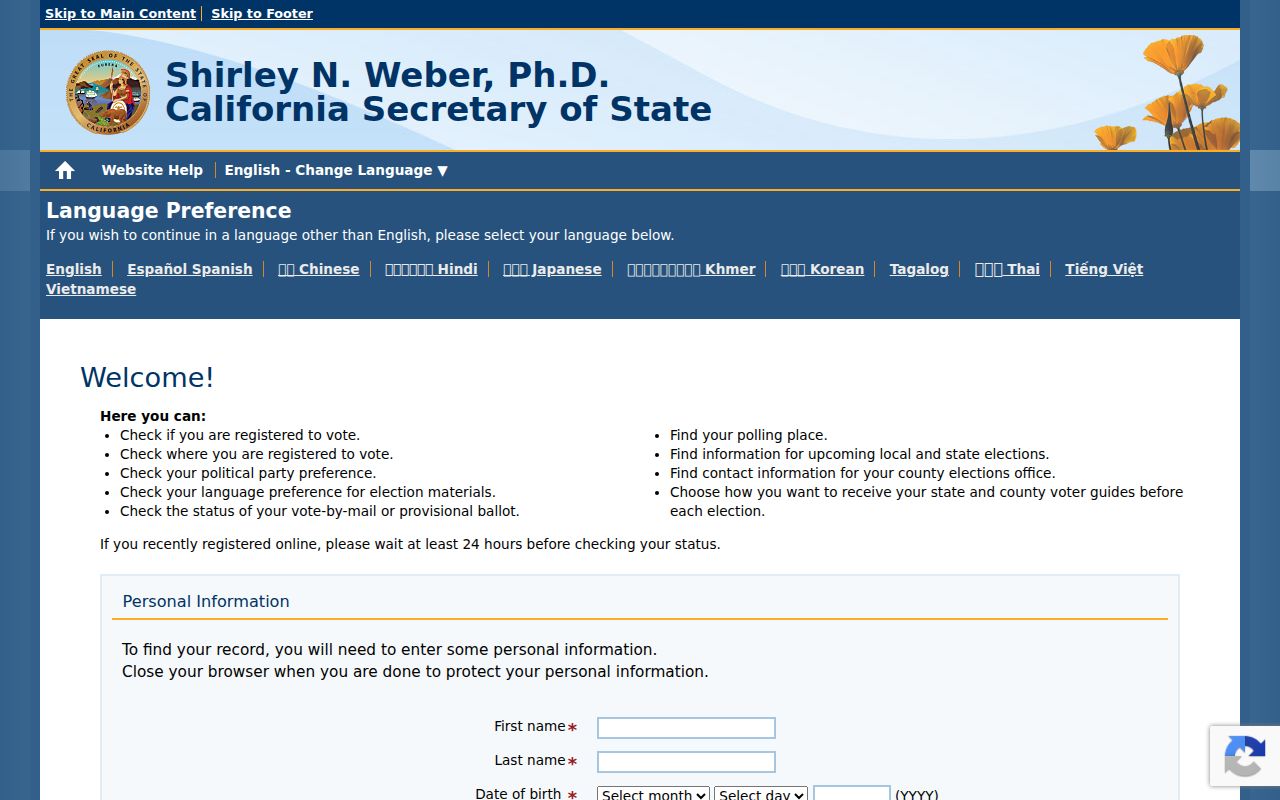
The state and county options serve the voter, while controlled voter-file access follows a different process.
Note: Do not send birthdates or residence details through an unofficial form when either government self-check is available.
Map Los Angeles Voter Records
California regulations define a broad record inventory, but inclusion in that inventory does not make a field open for routine public display. Data may exist in an authorized file only to the extent it was supplied or maintained. Voting history records participation by election date and method. It never reveals how anyone marked a ballot.
| Identity | Name, registration county, unique registration ID, county voter ID |
|---|---|
| Contact and address | Residential and mailing address, phone, and email where supplied |
| Personal fields | Date and place of birth, gender, and language preference where maintained |
| Election profile | Party preference, precinct, registration date, method, status, and status reason |
| Voting services | Voting-assistance request and permanent vote-by-mail status where applicable |
| Participation history | Election date and voting method, with no ballot choices |
Active, inactive, and cancelled describe the condition of an entry, not a person's voting choices. The record may also show why the latest status update occurred. Anyone reviewing authorized data should keep the field definitions distinct and avoid drawing conclusions beyond what the status actually says.
Shield Los Angeles Voter Data
California's voter-data access regulations implement the limits tied to Elections Code sections 2188 and 2194. Residential and mailing addresses, phone numbers, email addresses, birth information, identification numbers, and other file fields are controlled data. Confidential voter records and protected categories are excluded from ordinary release.
Confidentiality is the rule, not an optional setting. Elections Code sections 2188, 2194, 2188.2, and 2188.5, together with 2 CCR sections 19001-19013, limit access, purpose, storage, and transfer of voter data.
California's Safe at Home program provides a substitute mailing address to qualifying participants and helps keep an actual residence out of government disclosures. A protected address should never be treated as a missing lead to work around. Confidential elected officials and candidates also have special rules under Elections Code section 2166.9.
The access rules page shows the breadth of state safeguards. Consult the Secretary of State regulations before seeking or handling a file.
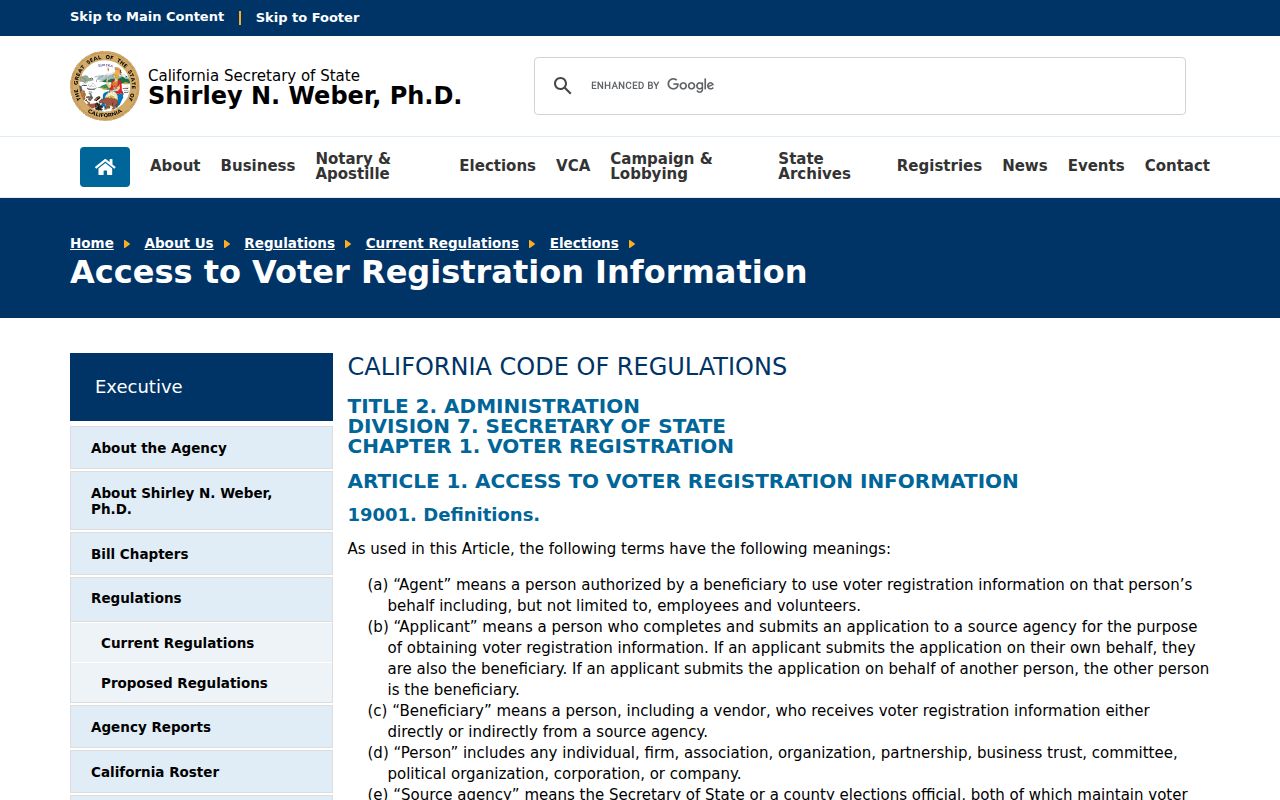
The official regulation set is the controlling source for approved purposes, security duties, and barred uses.
Request California Voter Records
The Secretary of State file request is reserved for election, scholarly, journalistic, political, governmental, approved record-review, or vendor work supporting another approved use. The applicant must identify the organization and intended use. Political requests need proof of affiliation when required, and a beneficiary must be named when another person or group will use the data.
- Complete the state application with full contact, business, mailing, organization, beneficiary, and intended-use details.
- Attach a clear copy of a current federal or state government photo ID and any required purpose documents.
- Sign the security agreement and provide a wet signature. The state does not accept emailed or faxed applications.
- Pay the required amount and deliver the packet in person, by U.S. mail, or by courier to the source agency.
The state material does not promise one universal delivery file format. Confirm the available format and delivery details with the source agency before submitting payment.
The applicant and any beneficiary must secure the file. A discovered unauthorized use or breach must be reported to the Secretary of State Elections Division Help Desk within 24 hours. California also bars transfer of voter information outside the United States as specified by Elections Code section 2188.5.
Order Los Angeles Voter Records
Los Angeles County offers an in-person or mail path through the Election Information Section. For an in-person request, complete the county form at the Registrar-Recorder/County Clerk. Appointments may be scheduled up to eight weeks ahead, and the county allows one person per appointment.
A mailed request must state the name, address, birth date, signature, and telephone number, and include a self-addressed stamped envelope. Send it to Registrar-Recorder/County Clerk, Election Information Section, 12400 Imperial Hwy., Room 2013, Norwalk, CA 90650. For procedural help, call (800) 815-2666, option 4.
The county request page displays the certified-copy, history, and name-search channels.
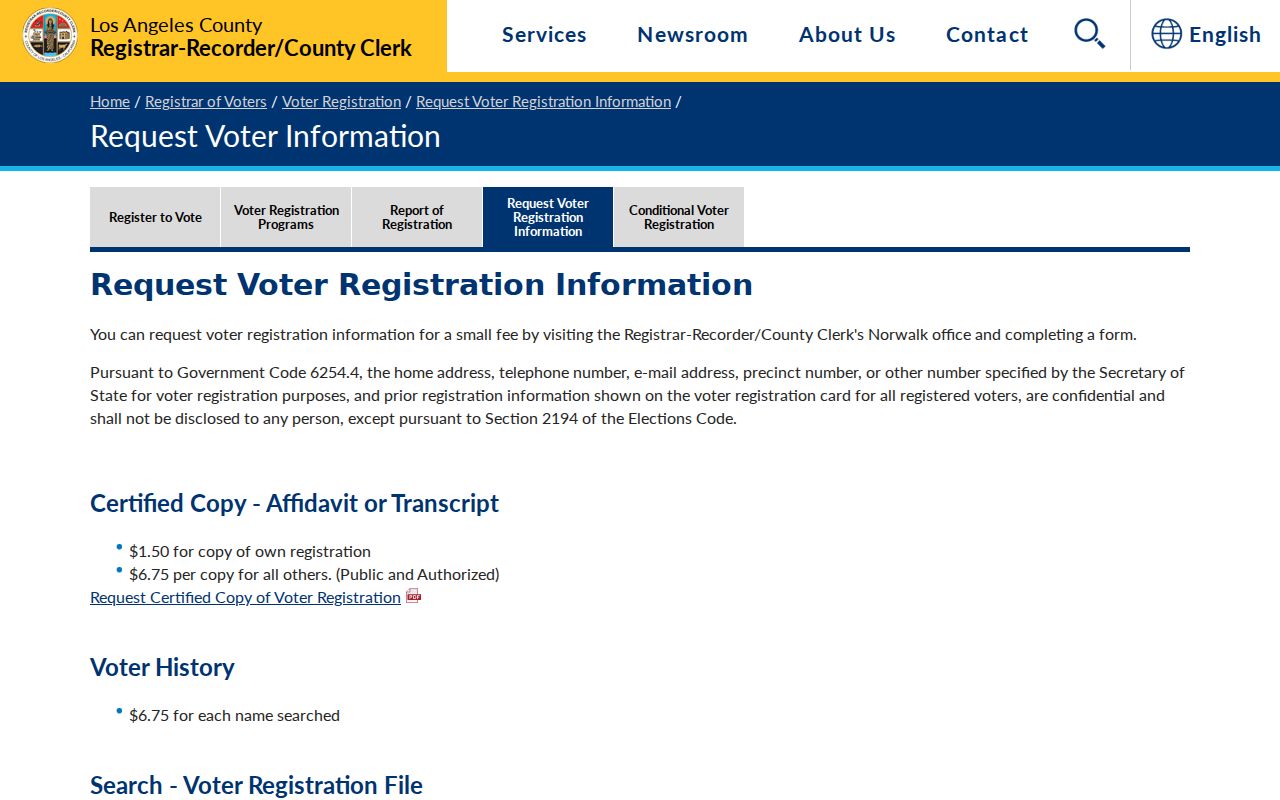
The county screen is the best check for the current form and counter instructions before a trip to Norwalk.
Note: The general California Public Records Act process is separate; see the Los Angeles public records request overview for that broader framework.
Compare Los Angeles Voter Fees
State and county charges use different units. The state charges $15 per 1,000 records, with a $15 minimum and a $100 maximum. A request for specific state voter records costs $30 per record, is capped at $100, and is limited to 10 records per request.
| Source and item | Charge | Key limit |
|---|---|---|
| California bulk file | $15 per 1,000 records | $15 minimum, $100 maximum |
| California specific record | $30 per record | Up to 10 records, $100 maximum |
| LA County own certified copy | $1.50 | Requester's own record |
| LA County other certified copy | $6.75 per copy | Public and authorized requests |
| LA County voter history | $6.75 per name | Each name searched |
| LA County file search | $5 per name | Each name searched |
The county's broader election-data page brings the purchasing channels together. Review the official purchase information and fees before calculating an order.
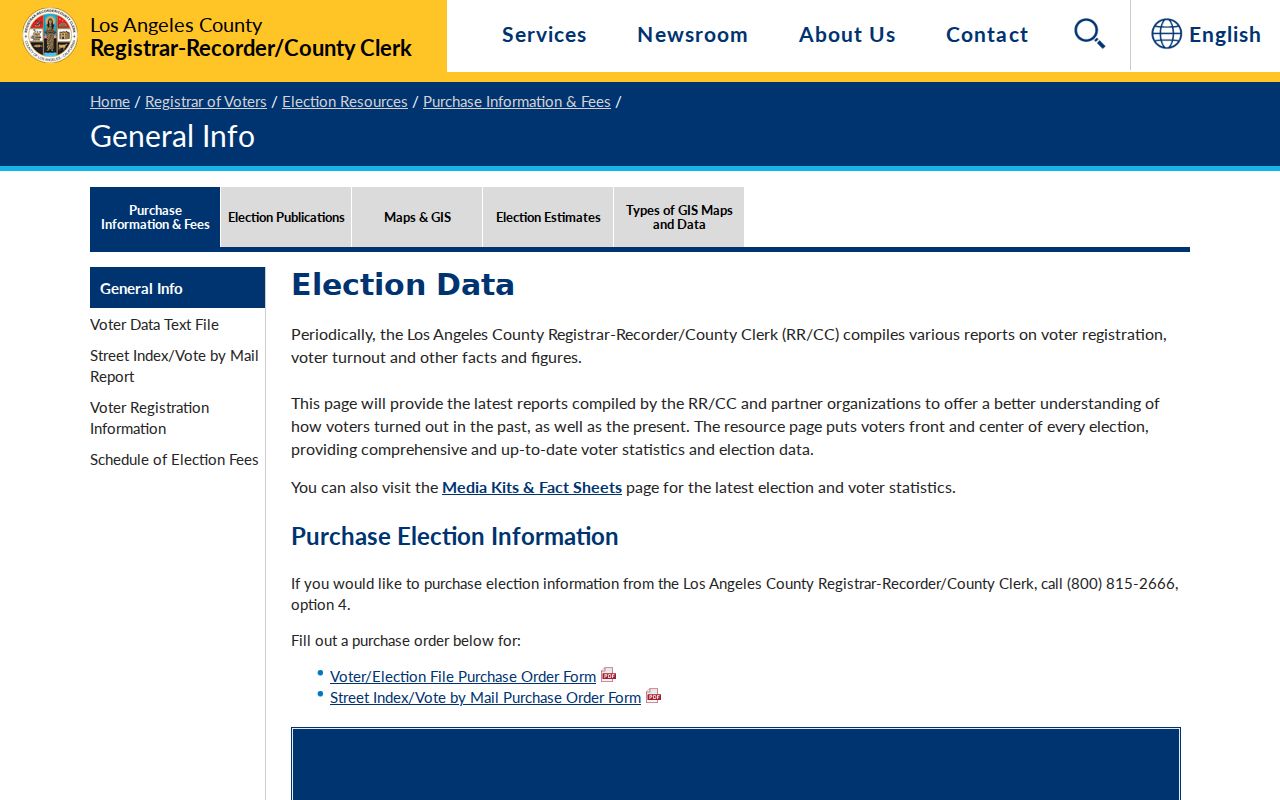
The published fee screen helps distinguish a single-name county search from a state bulk-file request.
Respect Los Angeles Voter Restrictions
Approved access does not permit every later use. California allows election communications, campaign-related surveys, political communication, election-focused scholarship and journalism, government functions, judicial proceedings, investigations, census work, approved list audits, and vendor processing for a qualified beneficiary. The stated purpose controls the use.
Keep voter data within its approved purpose. Personal, private, and commercial messages or solicitations, unrelated surveys, harassment of a voter or household, and unauthorized overseas transfers are prohibited.
Security duties continue after delivery. Do not republish the file, use protected details to trace a residence, or pass the data to someone whose purpose was not approved. If the need is simply to confirm personal status, use the self-check. That route asks for the least data and avoids needless possession of a controlled file.
Trace Los Angeles Voter Roll Changes
Registration lists change as election officials process address confirmations, returned mail, duplicate entries, death records, voter requests, felony-imprisonment status, and federal and state maintenance rules. An inactive entry is not the same as a cancelled one. It may reflect an address-confirmation process, while cancellation requires a recognized statutory trigger or an NVRA-compliant failure-to-respond and voting cycle.
Los Angeles County describes its elections operation as the nation's largest and most complex local election jurisdiction, with more than 500 political districts and more than 4 million registered voters. That scale helps explain why exact address matching, precinct assignment, and current status matter so much. It does not reduce the privacy controls on the roll.
Older voter research needs another route because exact local poll-book and register holdings were not verified in the available archive descriptions. Start with the California State Archives, then use county election archives, Los Angeles Public Library newspapers, campaign material, and historical city directories. These sources can document elections, precincts, civic activity, and residence without treating a modern restricted file as a genealogy shortcut.
Los Angeles Public Library's city directories offer a useful time bridge. Its film and paper Los Angeles directories cover 1873 through 1942, while digitized city and street-address directories span 1875 through 1987. A name entry may establish a residence, spouse, or occupation in a given year. Newspapers can then add election notices, district news, candidate material, and civic activity. None proves that a person cast a ballot, but the sources can place a person in the local setting when a poll book is unavailable.
Note: Historical directories and newspapers are alternatives, not substitutes for a current official registration-status result.